Pendleton Round-up began as a fourth of July celebration in 1909. Searcy’s account of the first Round-up states, “[t]here was horse racing and bucking horses…Nothing was very organized but the bruised and dust laden cowboys who limped back “uptown” from the gravel bar on the river where the events were held nourished roots that were deeply implanted in the soil of Eastern Oregon” (57). Indeed this allusion to the roots, river and soil of Easter Oregon is justified. Just as the industrial success of the town was linked to the ecology of the region, so was the development of the Round-up “homegrown”. Furthermore, just as Pendleton’s industrial success with textiles was intimately linked with the town’s proximity to the Umatilla Reservation, so is the town’s cultural identity indelibly marked by the iconic image of “cowboys and Indians”. The Pendleton Round-up, an annual event which has become as synonymous with the town as the Pendleton Blanket, relies strongly upon these American West icons. From the earliest Round-up Indians have been active participants. On September 29, 1910 the first official Pendleton Round-Up began. Gilbet Minthorn of the Umatilla led a number of his people to the cottonwoods alongside the Umatilla River and set up tipis there (Rupp 4). Indian parades and dances were held as part of the first celebration (5). In 1911, Pendleton Woolen Mills sponsored and Indian race which had a $250 prize (7). Pendleton Mills and the Bishop brothers were instrumental in encouraging Indian involvement in the early years of the Round-up. Authors Ronald J. Pond and Daniel W. Hester note that “[i]n the early years, the people held on to their traditions and practiced them at the Round-up Grounds and Indian Village” (133). Such traditional practices include the construction and use of sweathouses, and large tribal dinners. Other traditions specific to the Round-up have developed. Pond and Hester write: 1911, Pendleton Mayor Roy Raley wrote the Wild West show…called the Happy Camp Pageant…The story told…was rife with stereotypes, yet efforts to update the show have been thwarted. The paegent in its original form is still held dear to many, giving all who participate a chance to laugh at themselves once a year. The Indian participants know their roles just like people remembered their camping places in the Indian Village, and those roles have been passed down to the younger generations (133). 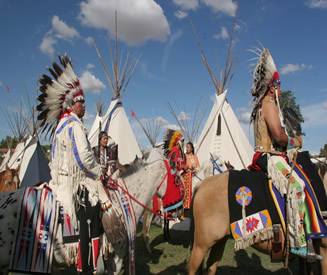
Monday, August 18, 2008
Happy Camp and Indian Village
Friday, August 15, 2008
Woolen Mills Finale & Round-up Tease
Despite the bleak outlook, textile production at Pendleton was not over. In February 16, 1909, ownership of the Pendleton Woolen Mills changed hands. New owners, from a prominent family with a history of successful textile businesses, Clarence and Roy Bishop “eagerly accepted the challenge of the management of the new company” (Lomax 274) The Bishops felt that the mill needed substantial physical and mechanical improvements before the business could resume. Working alongside a construction crew, the Bishops oversaw the building of a new three-story cement facility on land adjacent to the Union Pacific Railroad Company’s tracks. By September 1, 1909 construction was complete (274). The Bishops intended to continue the Pendleton production of Indian blankets and robes. The brothers employed Joe Rounsley, of the Philadelphia Textile school, to develop designs for the company’s Indian blankets. Rounsley’s product was “pure art, conceived by…living with the Indians” (276). In 1912 the Bishops procured the recently foreclosed Wahougal Mill in Washougal Washington (277). This purchased marked the beginning of a series of expansion moves the Bishops would coordinate. The expansions were used as a way to diversify product lines. During WWI Washougal produced army blankets while the Pendleton mill continued to produce Indian products (277) After the war, Pendleton began to develop virgin wool products and market them under the Pendleton blue and gold brand (279). By the late 1940’s Pendleton Woolen Mills Inc. came to include facilities as far away as Nebraska (300). Today Pendleton Woolen Mills is still operated by the Bishop family, and consists of seven facilities and 75 stores. The mill located in Pendleton Oregon continues to be the site of all Pendleton Indian blanket production (“About Pendleton”). I'm hoping to find information regarding the ecological impact of the Indian blanket production that goes on at Pendleton. I am concerned that the intense colors of the blankets may mean that significant pollution from dyes is part of the process. So far I have found very little information. What I do know is that Pendleton has taken a public position advocating sustainability. Of course in this political and social climate this is a smart market move, but it is still significant. Image of Pendleton Round-Up Blanket Lomax, Alfred F. 1974. Later Woolen Mills in Oregon, First Edition, Binfords & Mort,Portland, 301.  My next research endeavour is the Pendleton Round-up. So far I have a lot of fantastic vintage pictures depicting the Round-up's history, stay tuned for the visual feast.
Wednesday, August 13, 2008
Pendleton Woolen Mills and Woody Guthrie
As promised here's part two of the Pendleton Woolen Mills Saga: In the late 1890’s the pro-business East Oregonian newspaper ran an editorial extolling the virtues of suits made from wool that was raised, spun, and woven in Umatilla county. Although this promotion likely helped business at the young Pendleton Woolen Mills, manager and stockholder Theron E. Fell’s plan was not to focus on the production of suiting materials but rather to focus attention on selling blankets and Indian robes to the nearby Umatilla reservation (261) The total Indian population of the United States at the dawn of Pendleton Woolen Mills was approximately 263,000 people. Populations in the Northwest were approximately 4000 in Oregon, 10,000 in Washington and 12,500 in California (261). Shortly after the opening of the scouring plant, then scouring plant manager Theron E. Fell had “talked hopefully of a woolen mill” (257). By mid-July 1898 Pendleton Woolen Mills was legally incorporated and plans for the mill were made public. However, raising money for the venture was slow. Lomax states that “Money-raising was always a difficult task…but especially at this time when the country was just emerging from the panic conditions of the early 1890’s” (258). Despite delays caused by the economic slump the Pendleton Woolen Mills began operation on September 7, 1896 (260). “The company took particular pains to weave the correct designs and color demanded by the Indians…Robes with colors acceptable to the Crows in the north were unacceptable to the Navajos in the southwest. To meet this diversified demand and to assure accuracy in manufacture, a factory representative visited the various reservations” (261). Such attention to detail paid off, and Pendleton blankets sold well on the reservations. One store in Yakima, Washington placed an order for 1000 blankets in March 1897 and estimated that an additional 1500 would be sold that year (262). Pendleton products also sold well off the reservation. Robes in school colors were popular at colleges and universities, steamer rugs sold well in the east. But Pendleton remained primarily focused on the production of Indian blankets and robes. They worked to capitalize on the idea of the “romantic western Indian” to sell these products off the reservation. Early advertisements explicitly announced the connection between the Pendleton Mills and the Umatilla reservation pointing out that Pendleton robes are to Indians what a “Paris hat is to a Chicago girl on Easter morning” (264). In 1902 further investments were made in advertising. A number of well-known Indians were photographed wearing Pendleton robes, and these images along with a variety of images depicting Pendleton’s being used indoors and out were reproduced. An eight page booklet showing suggested uses for Pendleton robes was also produced from these images (268) Despite initial success, the first woolen mill at Pendleton did not last long. Using a number of primary source documents including legal proceedings, newspaper articles, and property leases Lomax infers that the Pendleton Mill went idle around 1907 (271). His sources seem to indicate that both economic problems in the region and legal problems at the mill played a role in the company’s collapse. Photo:. Umatilla County: A Backward Glance. Compiled by theUmatilla Historical Society. Published by E. O. Master Printers, Pendleton. 1980. Lomax, Alfred L. Later Woolen Mills in Oregon. Portland:Binfod and Morts, 1974. As an aside to all this Pendleton talk, I had the privilege of watching a 1950 film called "Columbia" which was put out by the Boneville Power Administration. It was one giant ode to dam building as a force for colonization and weapons manufacture. It was totally disturbing and would have been funny had it been fiction. The entire musical score was Woody Guthrie...
Tuesday, August 12, 2008
Pendleton Oregon, a Wooly Idea

As I'm sure I've probably mentioned ten times or more in the course of this blog the due date for my paper in Columbia Basin History and Ecology class is fast approaching. For my topic I had weeks ago decided on Pendleton, Oregon. This choice was not completely random, but might as well have been since I was only passingly familiar with Pendleton due to their line of Indian blankets and robes. Since beginning my research I've learned a great deal about the town, and I'm glad I picked it as my topic because the story of Pendleton is bizarre and fantastic. In light of my new deep love for Pendleton's history I intend to post a series of blogs about my findings. I hope you'll all find them as interesting as I do.
In Pendleton there are historically two facilities which are involved in the production of wool. One is the Pendleton Wool-Scouring and Packing Co. and the other is Pendleton Woolen Mills. The county of Umatilla, of which Pendleton is the seat, was a major wool producer in the late 1800's. In December 1893 “the Pendleton Wool-Scouring and Packing Company was incorporated with capital stock of $12,000 in $50 shares” (Lomax 245). The first $6000 in preferred stocks sold quickly but sales lagged and the committee worked hard to solicit support from woolgrowers and townspeople. Editorials ran in the East Oregonian such as this by CS Jackson “Now it is your duty and to your interest Mr. Woolgrower, Mr. Business Man, Mr. Property Owner…to take one or more shares in the enterprise!” (246)
In 1894, right around the time that the mill was beginning operations, optimism was high (optimism in those days seems on paper at least to have always run high). Board Director E.Y. Judd stated “I expect to see Pendleton the most important wool market in Oregon” (247). Indeed Mr. Judd was correct, in 1894 daily scouring capacity was 15,000 pounds on the day shift and warehouse capacity could hold 1 to 1.5 million lbs of wool (249). By late 1894 “Pendleton was…established as an important primary wool market. Buyers from flourishing Willamette Valley mills came regularly to Pendleton” (250).
The Pendleton Woolen Mills began around 1895 and were originally deeply invested in producing and marketing "Indian Robes".
to be continued...
Tune in next time for The Pendleton Woolen Mills "the emporium of Indian fashion".
Picture 1: Pendleton Scouring Plant circa 1900. Umatilla County: A Backward Glance. Compiled by the Umatilla Historical Society. Published by E. O. Master Printers, Pendleton. 1980.
Lomax, Alfred L. Later Woolen Mills in Oregon. Portland:Binford and Morts, 1974.
Picture 2: Mill Creek Trading