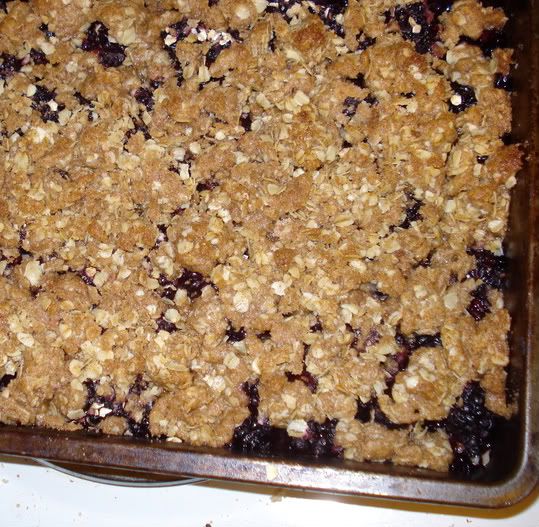
Ingredients Topping Ingredients CAKE: Mix flour, sugar, cinnamon, nutmeg, baking powder and baking soda well. Add oil, yogurt, vanilla and soy milk and mix thoroughly. Pour ingredients into a lightly oiled baking dish.
1 3/4 Cups Unbleached White Flour
1 tsp Ground Cinnamon
2 tsp Baking Powder
1/2 Cup Canola/Vegetable Oil
1 tsp Vanilla
1/2 Cup Sugar
1/4 tsp Ground Nutmeg
1/2 tsp Baking Soda
1 Cup Soy Yogurt
approx. 1/2 Cup Soy Milk
6 Tbsp Unbleached White Flour
1/3 Cup Turbinado Sugar (i.e. Sugar In The Raw)
Ground Cinnamon
3 Tbsp Soy Margarine
1/2 Cup Rolled Oats
TOPPING: In a separate bowl, mix flour, sugar, oats, and soy margarine. Add flour and sugar and cinnamon until you have a crumb topping, then sprinkle on top of coffee cake. Bake at 375 degrees for about 30 minutes, or until a knife or toothpick inserted in the center comes out clean.
Saturday, April 11, 2009
Coffee Cake for Bird
Thursday, December 4, 2008
Introduction So Far

On November 9, 1989 representatives from fifteen countries gathered together to discuss the politics of food. From their discussion the Slow Food International movement was formed and began to promote their manifesto that, “[i]n the name of productivity, Fast Life has changed our way of being and threatens our environment and our landscapes. So Slow Food is now the only truly progressive answer” (“Manifesto” par. 8). Since its inception the Slow Food movement has spread to 122 countries. This movement is not the only one of its kind. In recent years the focus on food has been a critical part of the ecological movement, introducing new concepts and even new language to describe the human relationship with food (locavore for example). These movements represent a sensible ordering of thought around a logical central idea. Food is a logical point around which to organize ones feelings and actions regarding their relationship to nature and resource use, because food is one of the few items that make obvious human reliance on and interconnection with the natural world.
The body of American literature contains multitudes of works focused on humanity’s relationship to the natural world. Many of these works, especially in the 19th and 20th centuries, rely upon a worldview which vilifies the urban and elevates the wild as a sacred place apart. This tension between urban and wild is a central element in Willa Cather’s 1925 novel The Professor’s House. Characters such as Tom Outland and Louis Marsellus seem emblematic of this dichotomy. Even their names provide support for this concept, Outland (out-land) as the mesa dwelling place apart, and Marsellus (mar-sell- us) as the eager capitalist who Cather portrays as corrupter of Outland’s legacy. While this division has been widely accepted in many circles for generations, the concepts of glorified “wild” and vilified “capitalist” are not in the end polar opposites, but rather reflections of a similar human desire to manipulate and organize the natural world while conveniently ignoring the relationship between humanity and nature that exists at all levels of landscape.
A useful place for interrogating this binary in The Professor’s House rests in Cather’s representation of gardens. According to garden enthusiast and philosopher Mara Miller, “[t]he task of the garden is to mediate those tensions or polarities which are important for a given culture” (25).
Wednesday, December 3, 2008
Ending with a Boom/ Beginning with Slow Food
It was the last regular day of 121 for my classes today. We ended on a great note, especially in my 10 am class. They were so intensely interested and interactive, it was tremendous. We laughed and joked and learned. I was totally delighted by the experience and I hope some of them will end up in my 214 class.
Monday, October 13, 2008
One Big P-Nut Butter Cup and More
So I made cookies yesterday, or should I say one big cookie. Using my powers of experimentation I came up with a giant peanut-buttery-choco cookie of delight.
Today at school it was return to conferences.
Nine students...
Two who brought next to nothing
&
One who didn't really need a conference
Just five more conferences to go, then Wed it's back to the teaching grind whence I'll be experimenting with teaching the Information Literacy Portfolio, and conducting a workshop for any students who bring in revision (if any do).
We'll see...
Monday, September 15, 2008
Fruit of the Harvest: part 1

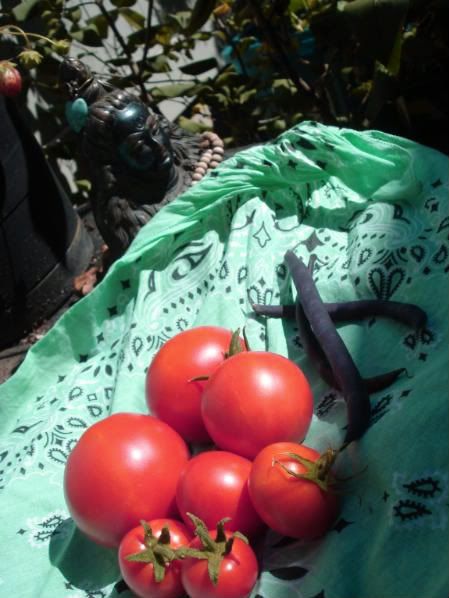
The past few days have been full of harvesting, prepping, and cooking. We've gathered blackberries, plums, pears and apples. We've also had a steady flow of tomatoes from the garden, and some beans have been collected as well. Add to this a great buy on Italian prune plums at the grower's market and that has made for busy times. It's also made for delicious times well worth sharing (click the links for photos of the delight).
Wednesday, September 10, 2008
Free Fruits
We went to EE Wilson for the second day of vegetation surveying. Things went smoothly. I saw a lovely dry marsh and plenty of fruit trees growing wild. I ate some Asian pears and apple or two. Bird and I filled her pockets with plums and a big bowl of blackberries. All delightfully free.
a little more fruitiness... is this a Georgia Peach
Wednesday, September 3, 2008
Cooking and PowerPointing
The night is wearing on and despite the fact that I worked diligently on my teaching materials all day I haven't progressed past week one's PPTs. Maybe it's the fact that at almost 9PM I haven't had dinner yet but I feel somewhat confused and sleepy as I try to recall the events of my day.
Sunday, August 31, 2008
Sustainability Sunday: Here Comes the Rain Again
For those who may now know it, Rain is the name of the game in many parts of the Pacific Northwest. Newport Oregon for example receives an average annual rainfall of 68 inches. Here in the Willamette Valley however we receive an average of 42 inches per year. This is not drastically different from the annual precipitation back in Blackstone Ma (48 inches). The main difference here is that our average winter temperature in Corvallis is near 40 F compared to Blackstone's 22ish degrees.
GMO Labeling: Threat Or Opportunity?
Peter W.B. Phillips and Grant Isaac
University of Saskatchewan, Canada
AgBioForum