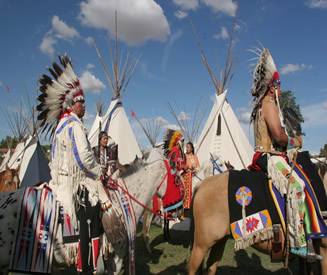
Pendleton Round-up began as a fourth of July celebration in 1909. Searcy’s account of the first Round-up states, “[t]here was horse racing and bucking horses…Nothing was very organized but the bruised and dust laden cowboys who limped back “uptown” from the gravel bar on the river where the events were held nourished roots that were deeply implanted in the soil of Eastern Oregon” (57). Indeed this allusion to the roots, river and soil of Easter Oregon is justified. Just as the industrial success of the town was linked to the ecology of the region, so was the development of the Round-up “homegrown”. Furthermore, just as Pendleton’s industrial success with textiles was intimately linked with the town’s proximity to the Umatilla Reservation, so is the town’s cultural identity indelibly marked by the iconic image of “cowboys and Indians”. The Pendleton Round-up, an annual event which has become as synonymous with the town as the Pendleton Blanket, relies strongly upon these American West icons. From the earliest Round-up Indians have been active participants. On September 29, 1910 the first official Pendleton Round-Up began. Gilbet Minthorn of the Umatilla led a number of his people to the cottonwoods alongside the Umatilla River and set up tipis there (Rupp 4). Indian parades and dances were held as part of the first celebration (5). In 1911, Pendleton Woolen Mills sponsored and Indian race which had a $250 prize (7). Pendleton Mills and the Bishop brothers were instrumental in encouraging Indian involvement in the early years of the Round-up. Authors Ronald J. Pond and Daniel W. Hester note that “[i]n the early years, the people held on to their traditions and practiced them at the Round-up Grounds and Indian Village” (133). Such traditional practices include the construction and use of sweathouses, and large tribal dinners. Other traditions specific to the Round-up have developed. Pond and Hester write: 1911, Pendleton Mayor Roy Raley wrote the Wild West show…called the Happy Camp Pageant…The story told…was rife with stereotypes, yet efforts to update the show have been thwarted. The paegent in its original form is still held dear to many, giving all who participate a chance to laugh at themselves once a year. The Indian participants know their roles just like people remembered their camping places in the Indian Village, and those roles have been passed down to the younger generations (133).
Monday, August 18, 2008
Happy Camp and Indian Village
Tuesday, August 12, 2008
Pendleton Oregon, a Wooly Idea

As I'm sure I've probably mentioned ten times or more in the course of this blog the due date for my paper in Columbia Basin History and Ecology class is fast approaching. For my topic I had weeks ago decided on Pendleton, Oregon. This choice was not completely random, but might as well have been since I was only passingly familiar with Pendleton due to their line of Indian blankets and robes. Since beginning my research I've learned a great deal about the town, and I'm glad I picked it as my topic because the story of Pendleton is bizarre and fantastic. In light of my new deep love for Pendleton's history I intend to post a series of blogs about my findings. I hope you'll all find them as interesting as I do.
In Pendleton there are historically two facilities which are involved in the production of wool. One is the Pendleton Wool-Scouring and Packing Co. and the other is Pendleton Woolen Mills. The county of Umatilla, of which Pendleton is the seat, was a major wool producer in the late 1800's. In December 1893 “the Pendleton Wool-Scouring and Packing Company was incorporated with capital stock of $12,000 in $50 shares” (Lomax 245). The first $6000 in preferred stocks sold quickly but sales lagged and the committee worked hard to solicit support from woolgrowers and townspeople. Editorials ran in the East Oregonian such as this by CS Jackson “Now it is your duty and to your interest Mr. Woolgrower, Mr. Business Man, Mr. Property Owner…to take one or more shares in the enterprise!” (246)
In 1894, right around the time that the mill was beginning operations, optimism was high (optimism in those days seems on paper at least to have always run high). Board Director E.Y. Judd stated “I expect to see Pendleton the most important wool market in Oregon” (247). Indeed Mr. Judd was correct, in 1894 daily scouring capacity was 15,000 pounds on the day shift and warehouse capacity could hold 1 to 1.5 million lbs of wool (249). By late 1894 “Pendleton was…established as an important primary wool market. Buyers from flourishing Willamette Valley mills came regularly to Pendleton” (250).
The Pendleton Woolen Mills began around 1895 and were originally deeply invested in producing and marketing "Indian Robes".
to be continued...
Tune in next time for The Pendleton Woolen Mills "the emporium of Indian fashion".

Picture 1: Pendleton Scouring Plant circa 1900. Umatilla County: A Backward Glance. Compiled by the Umatilla Historical Society. Published by E. O. Master Printers, Pendleton. 1980.
Lomax, Alfred L. Later Woolen Mills in Oregon. Portland:Binford and Morts, 1974.
Picture 2: Mill Creek Trading